| ||||||||||||||||||||||||||||||||||||||||||||||||||||||||||||||||||||||||||||||||||||||||||||||||||||||||||||||||||||||||||||||||||||||||||||||||||||||||||||||||||||||||||||||||||||||||||||
| ||||||||||||||||||||||||||||||||||||||||||||||||||||||||||||||||||||||||||||||||||||||||||||||||||||||||||||||||||||||||||||||||||||||||||||||||||||||||||||||||||||||||||||||||||||||||||||
| ||||||||||||||||||||||||||||||||||||||||||||||||||||||||||||||||||||||||||||||||||||||||||||||||||||||||||||||||||||||||||||||||||||||||||||||||||||||||||||||||||||||||||||||||||||||||||||
| ||||||||||||||||||||||||||||||||||||||||||||||||||||||||||||||||||||||||||||||||||||||||||||||||||||||||||||||||||||||||||||||||||||||||||||||||||||||||||||||||||||||||||||||||||||||||||||

ANNA McNEARY: I was both grateful for the very specific spatial constraints and nervous about them. Having a confined space to work within made it easier to assess if installation was “done” or if it needed a bit more. I really like the idea of being a meticulous planner, but I am not one, so my ideas of making detailed installation plans to follow didn’t happen. I’m honestly glad I didn’t do that. I just threw sculptures on the wall and moved things around until color and composition looked right, kind of like how I would approach painting. Luckily each piece is very lightweight and pretty easy to move, and I had more space within the window to move around and see what was happening than I thought I would. I think working intuitively ultimately fits the spirit of this project, which is sort of about gently bending the conventions of craft in the name of making something fun, loud, spatial, and decidedly non-functional.
NINA RUELLE: Constructing a quilt is often based on pattern and modularity. While the pieces in this window are a far cry from traditional quilts, are there aspects of those techniques that have carried over for you?

ANNA McNEARY:Yes, absolutely. I got the idea for this installation when thinking about the forms that household textiles take on when they’re actively in use. Rather than trying to literally replicate the lumpiness of a quilt thrown over a body or the curvatures of a slipcover on a chair, I went in a direction where form takes on simpler, clean lines and defined geometry, definitely owing a bit to op art and even minimalism. This soft-crispness is sort of what quilting, or designing a pattern in fabric, is all about. Generally, it can be very hard for me to let go of control, and I have made plenty of art that I now regard as overly-precious. So in that sense my interest in quilting has helped me a lot. It’s taught me to work more improvisationally and to make use of what’s on hand. Lately I don’t follow specific patterns with quilting projects. Instead I let color, shape and material act as loosely repeating motifs rather than elements of a strict pattern.
NINA RUELLE: You recently showed “Common Set” at Overlap Gallery in Newport, RI. This piece is a collection of partial garments, meant to be assembled by the viewers into fully realized clothes of their own design. What is it like to witness interaction with this work? Has anyone ever assembled an outfit you found truly surprising?

ANNA McNEARY: I developed Common Set slowly over a couple of years, and I gave a lot of thought to the ways in which each piece of the installation could be specific enough to be functional, but ambiguous enough to have multiple uses and applications in the construction of experimental clothing. I’m trying to prompt my audience to think about personal preference and identity, existing within a sense of collectiveness and shared experience. Of course there are specific combinations of pieces that I like a lot, and that I think work well. But my favorite part of watching people interact with this work is when they come up with uses that I did not imagine for the installation’s different parts, made possible by the multi-use shapes that I’ve presented. I’ve witnessed some moments where my audience has built really culturally- or personally-specific garments that I simply would never have been aware of without observing them. I’m always a little skeptical of “neutrality” as a concept, but as intended, there is an open, unscripted quality in this project that enables that kind of engagement. At this point in time, when I fold interaction into my work, my highest goal is to get away from the prescriptive, and to design an interactive space that works more like a set of tools that my audience can use in response to the prompt that I’m offering.
NINA RUELLE: You often use performers or invite participation in your work, where physical acts become stand-ins for social exchanges. In “Ravel” (2018), two performers knit and unknit blankets with each other. In “In Exchange” (2018), participants share removable parts of clothing as they navigate the exposure and protection of themselves. In your instagram post about this installation, you mention that the process of hanging the show felt like creating a set that you were performing in. What was this like? Did you get much attention from passers-by?


ANNA McNEARY: For this installation I was really guided by color more than the source of materials I used. I try to make use of what I have on hand when starting a new project, so a few fabrics came from my fabric stash. I also frequent a fabric store in Massachusetts that sells a lot of funky deadstock stuff, and purchased the rest from there. They are very nice there and it’s never very crowded so I was able to awkwardly take over a corner where I laid a bunch of bolts out on the floor next to each other and tried to figure out the color scheme. I knew roughly what I was going for (I’m really into the earthy jewel tones of the Haribo gummy bears palette right now) but since you never know what you’re gonna get with the weird deadstock selection, there was some improv involved. I like this store not just because of the discounts and the chance to make use of what’s lying around in the fabric graveyard, but because the limitations that come with a random offering of material often jog new ideas for me.

ANNA McNEARY: I came into RISD thinking that I wanted to learn weaving and incorporate fibers into my print work that way. But largely because of who my mentors were, and the fact that I was in a printmaking program, fabric printing and sewing became my areas of focus. I still combine the two very frequently, and I prefer to work with fabric over paper these days. In my opinion there are just more options as to how fabric can be used and transformed. It’s an inherently sculptural material. I actually didn’t know how to use a sewing machine until I went to RISD, and I never thought that I would try any kind of performance art, either. School did a lot for me in terms of exposing me to new ways of working and expanding my interests.
NINA RUELLE: In your professional life, you wear many hats: artist, teacher, curator. Do you find these different roles impact the way you approach your studio practice?
ANNA McNEARY: Since I was pretty young, my attitude about creative work has been that if I’m inevitably going to wear a lot of hats, they should compliment each other. Sometimes they can detract from each other (like, a busy semester probably means less time in the studio). But usually they are very intertwined. I think a lot about the advice I give my students and try to practice what I preach in terms of good habits– being curious about process, managing my time well, using writing as a tool to sort things out, drawing regularly, being accountable for eventually articulating purpose and meaning in my work, taking oneself seriously but not too seriously, etc. My students sometimes spark ideas and raise themes that end up informing my work. I think talking about art all day with students makes me a better curator, because good curators listen and unearth narrative connections based on what artists are telling them, combined with their own perspectives.
***********************************************************************************************************************

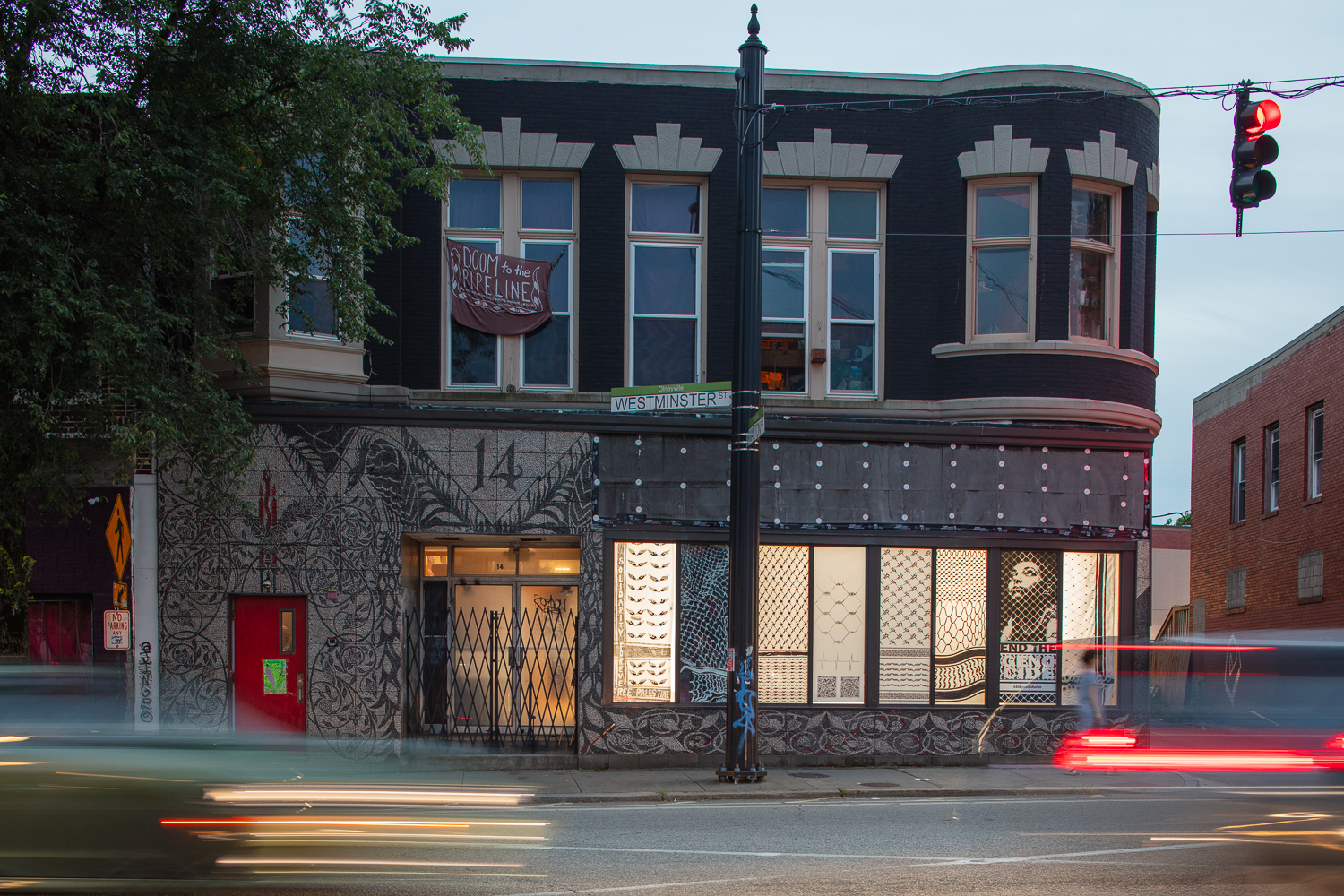
This past Summer WARP Collective did an Installation in the Dirt Palace Storefront Window Gallery.
WARP is a collective studio located in historic Atlantic Mills, Providence, RI. Currently our collective has 8 resident members representing varied interests and disciplines; Nat Brennan, Cybele Collins, Becci Davis, Lu Heintz, Jazzmen Lee Johnson, Jordan Seaberry, Eliza Squibb and Eric Sung. Our studio's infrastructure has an emphasis on pattern, textiles, printmaking and paper works. Our membership represents multiple ages, cultural backgrounds, and genders. We are interested in creating ties across various career stages and practices.
Below is an interview between WARP collective members and artist/educator Erik DeLuca
The Dirt Palance in Olneyville Square with a window installation by WARP Collective. (Photo credit: Dominique Sindayiganza)
The night before I left Providence for Palestine, I drove down Westminster Street, passing Olneyville New York System, until I reached the Dirt Palace Storefront Window Gallery, which was illuminated with the iconic pattern of the keffiyeh. The story goes that during the Arab Revolt in 1936, the British administration of the Palestine Mandate ordered that anyone wearing the keffiyeh was to be marked as opposed to the Zionist mission. This prompted Palestinians to wear the black-and-white headdress en masse. Several days later, after passing through what seemed like endless acres of settlement vineyards and farms on land dispossessed from Palestinians, I arrived in the contentious area of Masafer Yatta on an international law and human rights solidarity delegation. Living feet away from the Israeli settlement of Carmel, we visited the Bedouins of Umm al-Kheir who are battling constant tactics of forced transfer. Later, we drove just a few miles to the village of Sarura to meet with the nonviolent activists, Youth of Sumud that fight back against settler violence daily. Just before sunset, we headed back to occupied Hebron to discuss the AI-controlled machine gun at the Al-Shuhada Street checkpoint. All day, keffiyehs were worn en masse with dignity. On our way back to Bethlehem, we stopped at the Hirbawi Textile Factory—which I hear is Palestine’s only weavery still producing keffiyehs, founded by Yasser Hirbawi in 1961. His son Abdulla greeted us without words and led us to a warehouse full of mechanical looms. He turned them on one by one, with polyrhythms becoming more complex and vibrant. I watched his hands connect with the fabric. That familiar pattern came to form. I bought one. The tag on it read "Made in Palestine." This iteration of the Dirt Palace Storefront Window Gallery features the Providence-based WARP collective. We sat down recently to discuss their installation about the symbolism of the keffiyeh within a network of hands connected in solidarity and learning.
Erik: How does solidarity function for WARP?
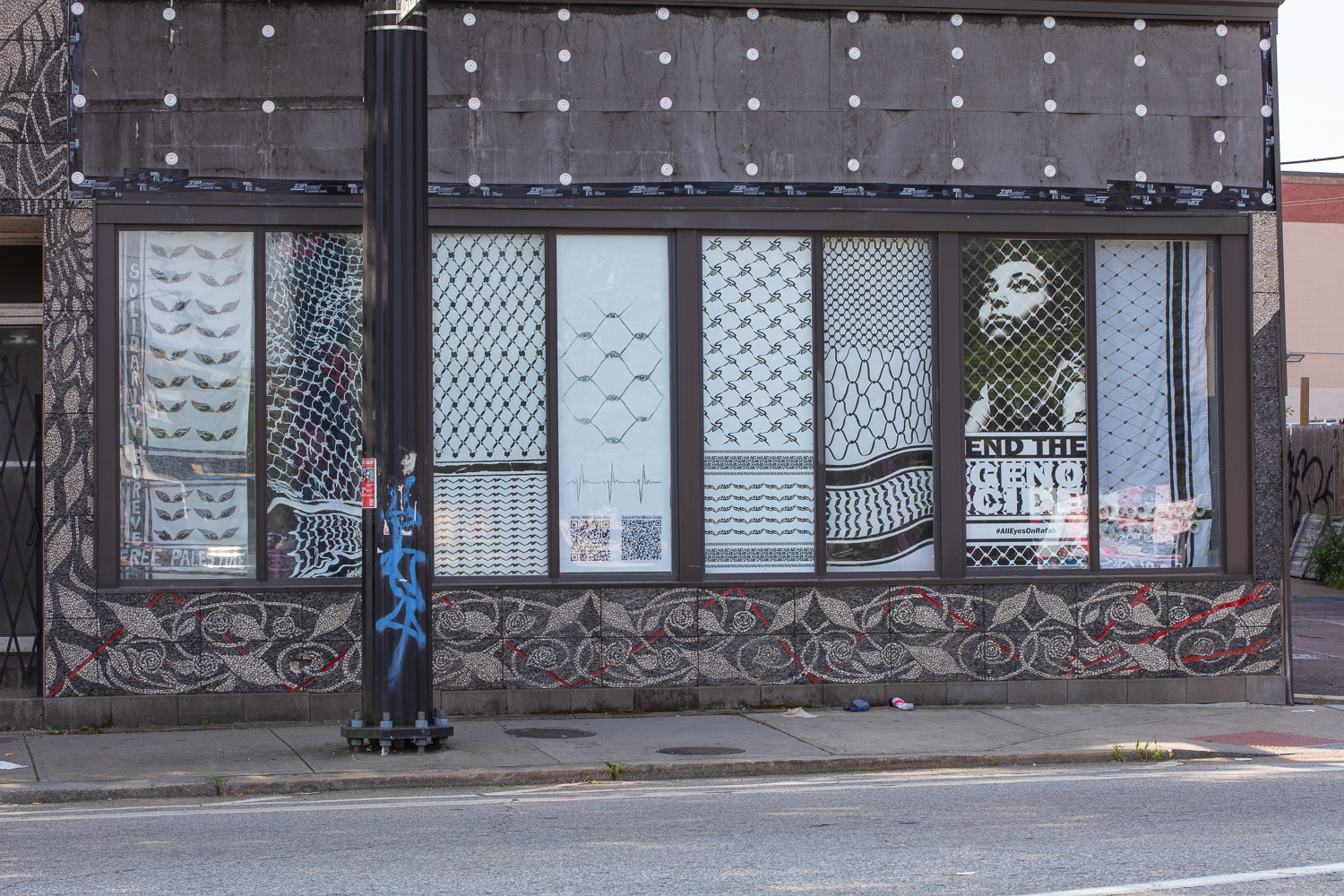
WARP: When we had the opportunity to share work in the Dirt Palace window, we all quickly agreed that we wanted to use this public visibility to make a collective visual statement for a free Palestine while also linking to the funding platform of Operation Olive Branch to support Palestinian families in Gaza.
E: What draws you to the pattern of the keffiyeh?
W: As a collective originally founded around the textile arts and working out of a historical mill building in Olneyville, we often return to textile patterns and techniques as a source of inspiration and metaphor. Our project explores the pattern of the keffiyeh, a scarf that originated among the Bedouin people and that continues to be worn in many arid regions of the Middle East as protection against the sun and sand. The black and white keffiyeh has been viewed as a symbol of Palestinian national identity since the 1950’s and later, as an emblem of Palestinian solidarity. The woven motifs in the keffiyeh represent connections to land, water, and heritage; universal human rights and experiences.
(Photo credit: Dominique Sindayiganza)
E: Tell us more about your art in the window.
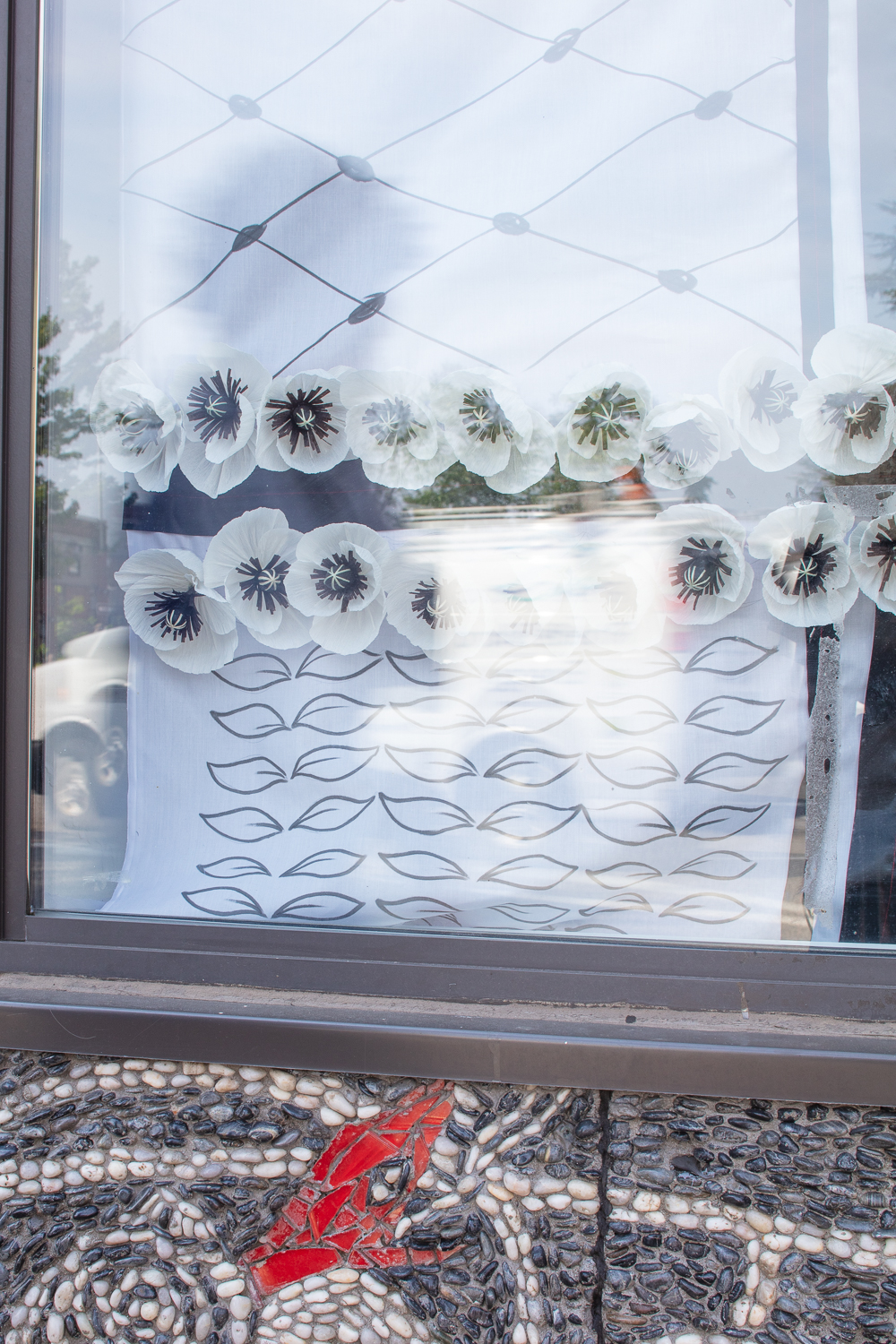
W: Working into the black and white forms, each artist in our collective could imbue the pattern with our own maker-style, visual references, and expression of solidarity. For example, two of the keffiyeh prints include sculptural elements with glazed ceramic sunbirds, the national bird of Palestine, and white paper poppies: native flora and fauna that are symbols of Palestinian indigeneity. This textile-based work, in particular, with paper poppies as the bold stripe across the bottom, features a hand-drawn net and olive leaf motifs with black ribbon sewn with red thread. Poppies are emblematic of sacrifice and remembrance across multiple cultures. They have added significance to the Palestinian people, their resistance, and connection to the land as one of the national flowers of Palestine and for the fact that, as they exist in nature, they include all three colors of the Palestinian flag.
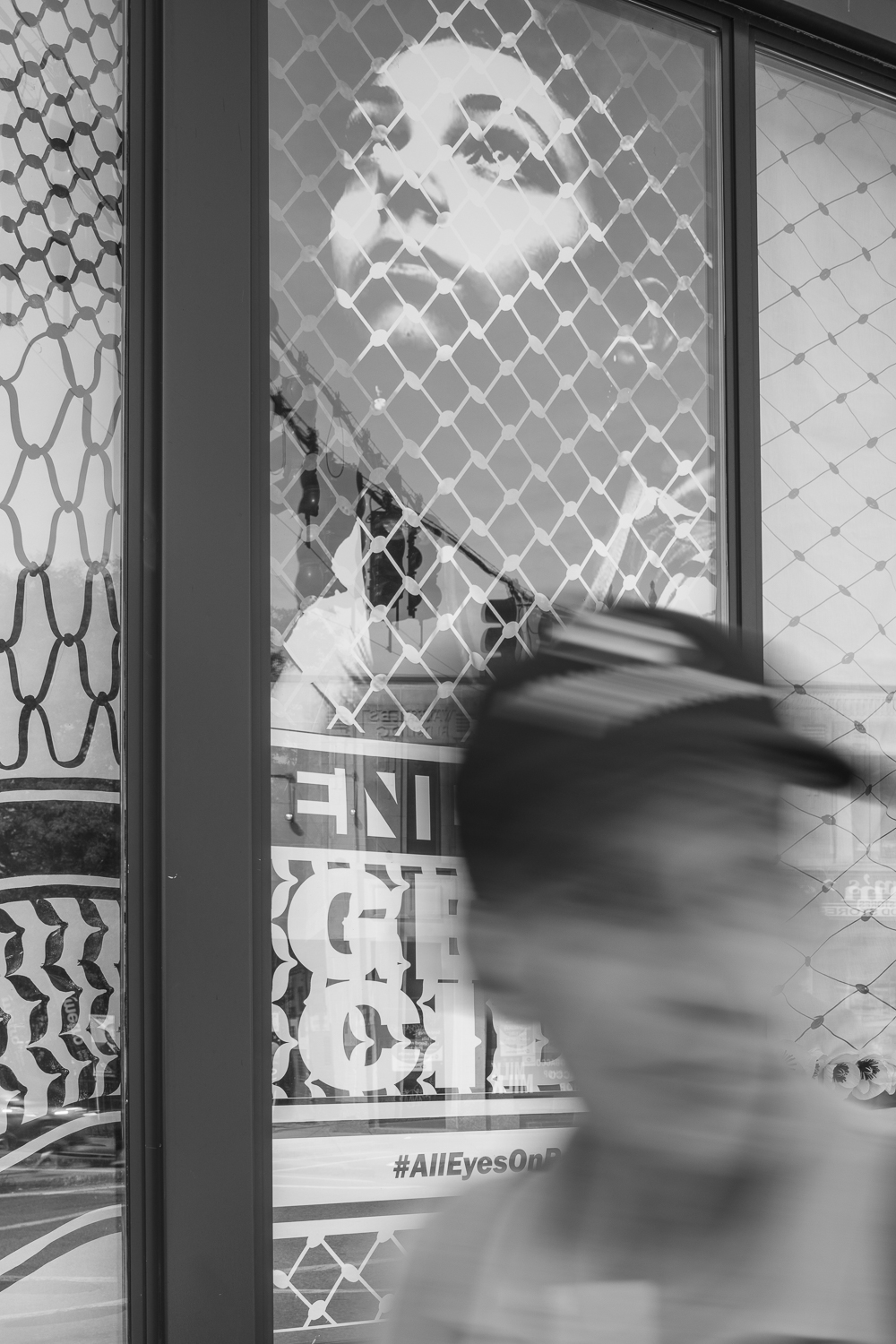
Detail shots of two prints referenced above with passersby. (Photo credit: Dominique Sindayiganza)
E: What is something unique that WARP learned during this process?
W: We learned that this unifying framework of focusing on patterns to unite all of our styles worked well for us. In collective art making, finding an equilibrium of freedom and individual expression, as well as unity and cohesion is a hard balance to strike. For this project, we all felt solidarity with the dire need to make a statement that Palestine must be free.