| ||||
| ||||
Friday, July 24, 2020
Window Gallery - Kah Yangni & Keegan Bonds-Harmon



Friday, July 17, 2020
Interview with Kah Yangni

Kah Yangni is an artist, illustrator, and muralist living in Philadelphia. Kah lived in Providence from 2009- 2019, and it was a pleasure to have them come back to PVD to do a mural in the Storefront Window Gallery.
Pippi: Your installation in the Dirt Palace Storefront Window Gallery quotes a song on the Solange album “Seat at the Table”, can you talk about the piece and your relationship to the lyrics?
Kah: I love that album so much. “A Seat at the Table” is an album long meditation on Solange’s blackness and her womanhood. I listen to it a lot. In the months before I came to do this mural, I would play this tiny song called “Interlude: I Got So Much Magic, You Can Have It” over and over and over.
The full lyrics of the interlude go: “you did it from the get go, get go, get go / let’s go, let’s go, let’s go / look for magic, ye-ah / they not gonna get it from the get go, get go, get go / don’t let, don’t let, don’t let / anybody steal your magic, ye-ah / But I got so much, y’all / you can have it, ye-ah.” It’s just three women singing acapella for less than thirty seconds.
To me the song is about how we have a magic that often isn’t recognized- and that even if it’s recognized and people try to steal it from us, it’s okay, because we have so much of it that we’ll be okay.
June was crushing. Every day was a flood of news about black people dying or people fighting against black people dying. I knew I wanted to do something that would be like a message in a bottle to anyone black or brown who passed the mural, to lift them and make them feel good at a time that was really dark.

P: How does music inspire or tie into your visual work? You sometimes use song lyrics in your illustrations and murals (along with quotes from activists) and as inspiration (I’m thinking of your shoebox Pride parade float for Vice inspired by Janelle Monae’s “Pynk”), and you are also a musician. I watched an interview where you talked about organizing Pronk! And your relationship to bringing people together through celebration. I’m curious if you see a connective thread between these different formats and mediums in which you work.
K: I love music! I have headphones on all the time, listening to podcasts or music. If I feel insecure, I listen to “Django Jane” or “Electric Lady” from Janelle- those songs are powerful, so for 2-3 minutes I’m sucked into the feeling of being powerful. I definitely feel like being a musician is a chance to literally embody a feeling. I’m a quiet person but as a musician I’m super loud! I can be covered in glitter, I can take my horn and start a party in an alleyway.
A music show or fest changes the culture for as long as it’s happening, but then it goes away. But visual art you can see and it can be with you all the time. A mural on a wall can last for years and years, and can change how people act around it. My overall artistic goal is to affect the culture in places the way a really good show does. So I am working to become a super strong visual artist and push myself to spread the work and make it large scale.

P: Your illustrations have an intimacy and care that feels deeply embodied…. I’m wondering about scale and how your work might shift when you’re creating something super large scale - like a mural. I’m setting this up like they would be oppositional - and I don’t think that’s the case - but I’m thinking about how your body exists in relation to the work when making something that’s small and maybe can be held in the hand (like a print) versus a large scale painting.
K: I’m trying to do the exact same thing but affect a greater number of people.
I put on my artist brain when I am designing the mural, and that feels the same whether I’m planning a mural or a print. I get to enjoy flow state. But painting a mural feels more like being a contractor.
Making murals is actually super physically uncomfortable. In the northeast, outdoor mural season is late spring through early fall. That means it’s hot and muggy. Maybe you’re sore from climbing ladders; you deal with people outside who are mostly nice but sometimes not; maybe someone peed near a wall you have to paint. But it is worth it because when you make giant art, you have the opportunity to change the energy of the space around that mural and make people think differently not only about themselves but about that block or that city even.
Xander: Print nerd question: you rock the rainbow roll a lot in your screen-printing work! In my experience with screen-printing I find that sometimes I do this out of a sense of efficiency (it can make a one or two color print way more colorful) but sometimes because I just want to experiment as I go and make each print a little different. Is your use of the rainbow roll related to either of these or something else altogether? It also seems like a natural extension of your work with watercolor. Can you talk a bit about how you think about screen-printing and how it connects with the other media that you work with?
P: You recently illustrated the National Women’s Law Center project, Brick by Brick, an advocacy curriculum that centers the experiences and identities of LGBTQ+ students of color designed for middle school and high school students. Can you talk about Brick by Brick, and your experience working on the project?


K: It was so funny to work on. I’m not even the target audience but I read it and felt like I was learning a lot.
I’m 29 years old. I have been out of the closet for more than ten years. But so much of what I learned from the curriculum, I learned for the very first time! I had never heard of almost any of it.
I read about these people in gay history and I felt like I was seeing myself and all my gay friends as we were moving through our twenties. We’re not weird- we’ve existed for a long time. We have our own history to be proud of. We’re real.
P: The illustrations in the Brick by Brick project are so multi-layered. They look like a combination digital, text, and hand painted scanned pieces.Can you talk about your process in creating these illustrations? Did you start with the text? The images? Did research play a part in creating these works?


K: I just started with reading the curriculum- clicking through all the links, watching all the videos. Then I started by drawing the people and the quotes by hand, on paper. I would paint pieces of paper with watercolor and take big sheets of screenprinted color and scan it all into the computer. Then I would use photoshop to combine and arrange it all. A little bit like a digital collage!
X: When landing on your website the phrase “I love art and what happens to people when they make it” comes up. This resonated a lot….locating a potential for change inside of the creative process. Then I quickly come to the print piece that features the text “Trans is freedom, is adventure, is endless”. These two sentiments, particularly when I hold them together offer a vision into change that is poignant. These two phrases say a ton already, but I wonder if you would be willing to share ways that art, change, and gender/identity and openness have intersected on your path.

K: I love this question! To me, being trans means I get to be creative with myself. Expression is super fun! It’s like a game or an adventure. I think that’s why you see a lot of trans and queer people allowing themselves to be more flexible with the way their families and relationships and lives look- because being queer in the first place, a lot of the time, is kind of creative. There isn’t a strong map that’s hundreds and hundreds of years old of what to be (like there is a map of how to be straight or be cis) so you create yourself a lot.
Making art is the same way- you make something totally new, and then it’s like you made a shift in the world. You can do things differently. It lets you know that you can build what you want.
 |
This project was made possible through support from the City of Providence, Art Culture + Tourism Department |

Friday, May 22, 2020
Interview with Keegan Bonds-Harmon
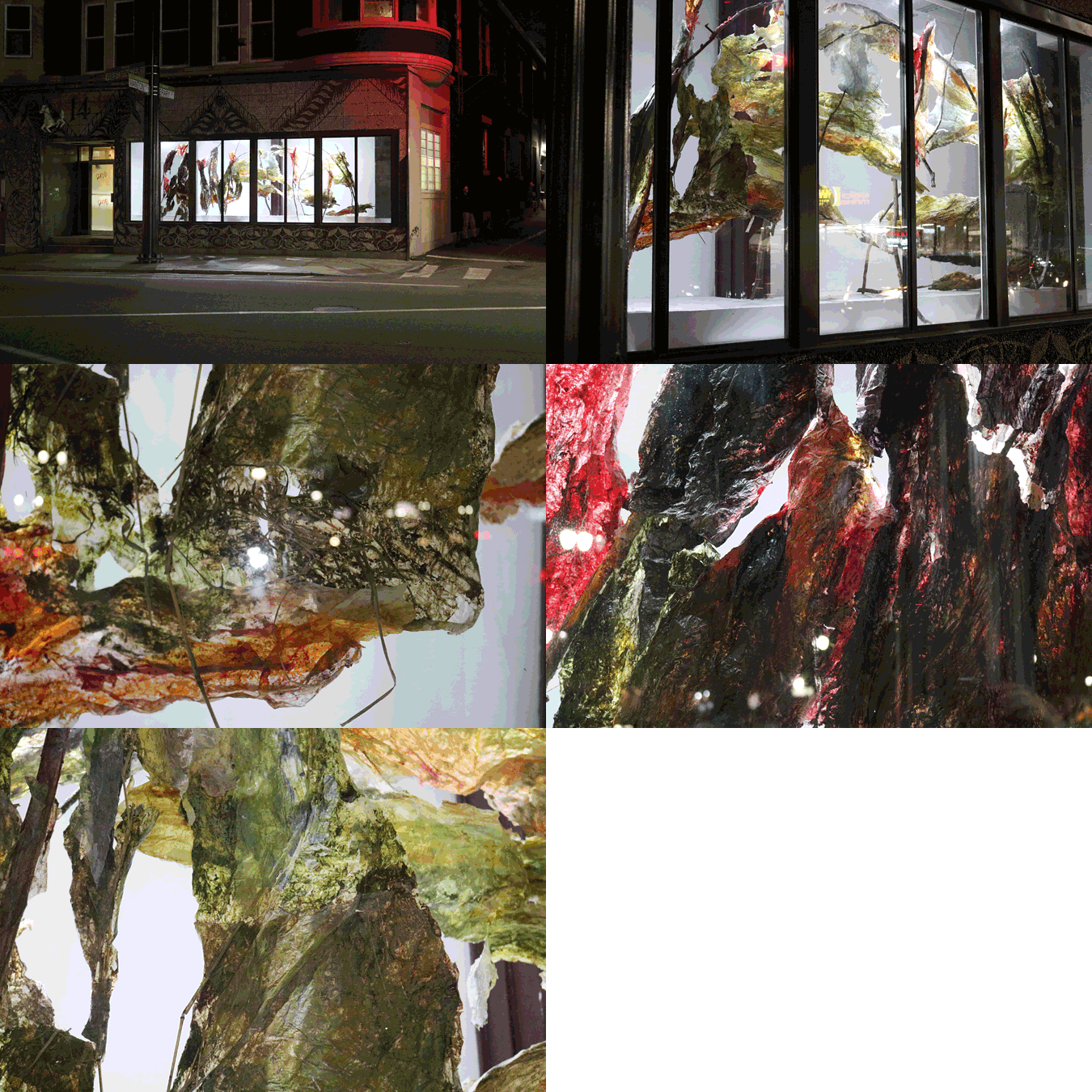
Keegan Bonds-Harmon is an artist and high school student born and raised in Providence RI, whose work incorporates painting, sculpture and video. Keegan's work will be installed in the Dirt Palace Storefront Gallery for all of May, through June 6th. The gallery is viewable from the street, so check it out next time you are walking or driving by! We did a live zoom interview with Keegan - here's a transcript of our conversation!

Pippi: Can you give us a broad overview of the ideas that you were thinking about in conceiving this project
I wanted to create a landscape related work that could be immersive to make and hopefully
to look at. This work, like much of my work, came out of material exploration. Last summer
I was making these figurative sculptures out of wheat paste and tissue paper. When I
flattened them out and they became more like paintings, shedded skins, wilted leaves, or
crusts. I was interested in their translucency. Otherwise, I kept it all pretty loose and used
these ideas as jumping off points.

Xander: You had started it before Covid, can you talk about ways that quarantine did or didn’t change the course of what you had imagined making?
I was about one third of the way into making it when we all went into quarantine and I think
the biggest shift was that I just stopped working on it for a while, which felt crazy. I’ve
always been the kind of artist to constantly work with whatever time I have. So to suddenly
have all the time in the world and to do nothing with it felt wrong. I went into what felt like a
hibernation for about three weeks. I spent more time reading, watching movies, walking,
calling friends, and scrolling longer than is healthy. But that felt like a necessary part of
adjusting to the strangeness and weight of everything.
When I started to work on the piece again I felt that I should try and stick to my original
ideation of it, even though the world it was entering was vastly different from the one it was
first being created. I am definitely now thinking about how my practice can adjust to this
new landscape as well as my own new rhythm, but at the time it felt too soon, and that
what I really needed in that moment was a distraction.
P: How did the manifestation of the project compare to what your initial imagination was?
Originally I had planned on making the piece in panels the exact size of each window. But
as I was working the sections were drying, shrinking, falling apart, and creating all new
shapes that I didn't want to control too much. Eventually I ran out of flour for wheat paste
and couldn't buy any at the grocery store because there was a shortage. I ended up
diluting the wheat paste and the work became more sparse. So even if I didn’t intend to
shift the work it had to shift, even if only on a material level.

P: Can you talk us through the process involved with constructing the piece? Where did
you gather the sticks, did you do all of the paper mache first and then and paint, or did you
start painting as you went along?

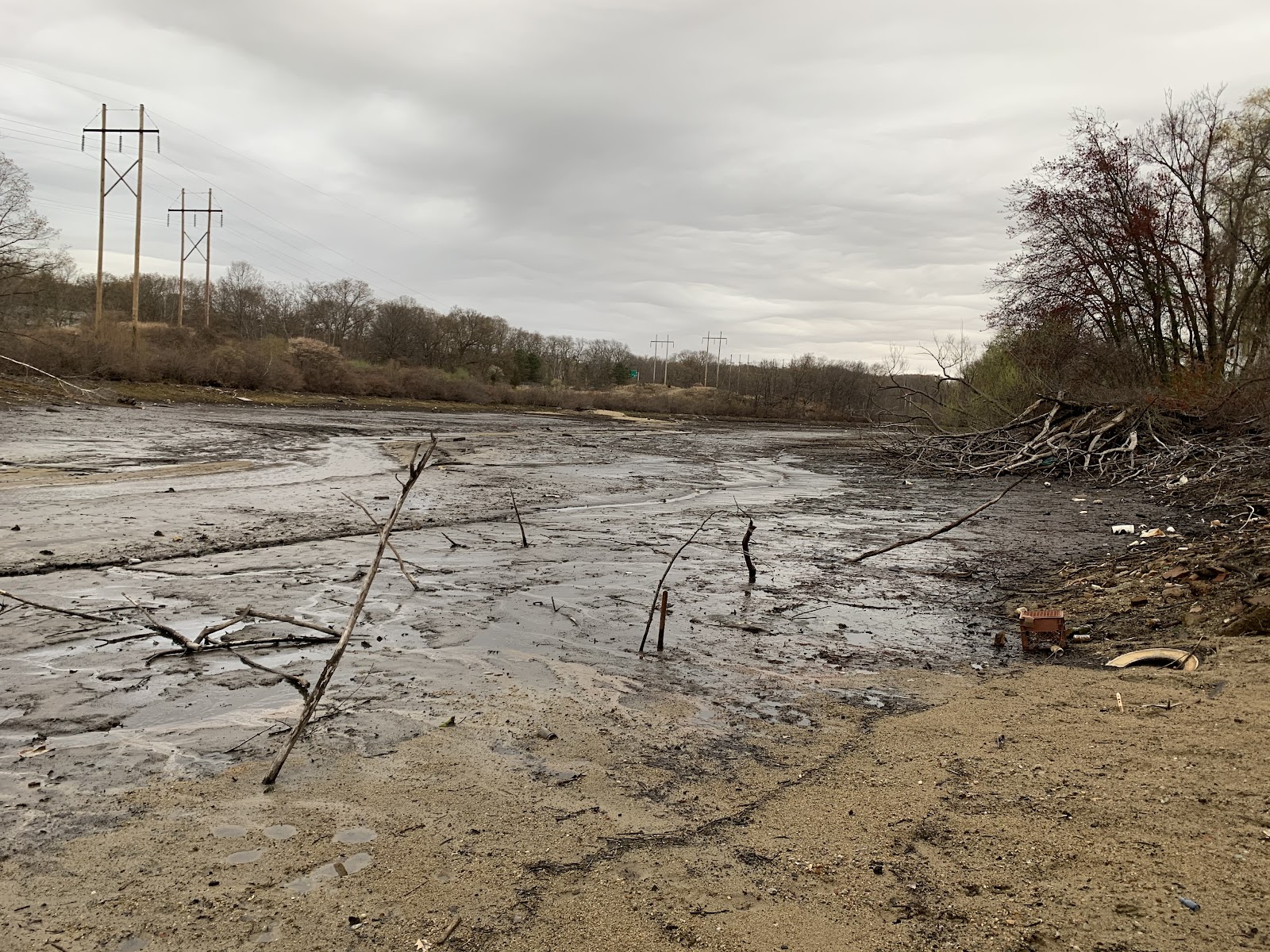
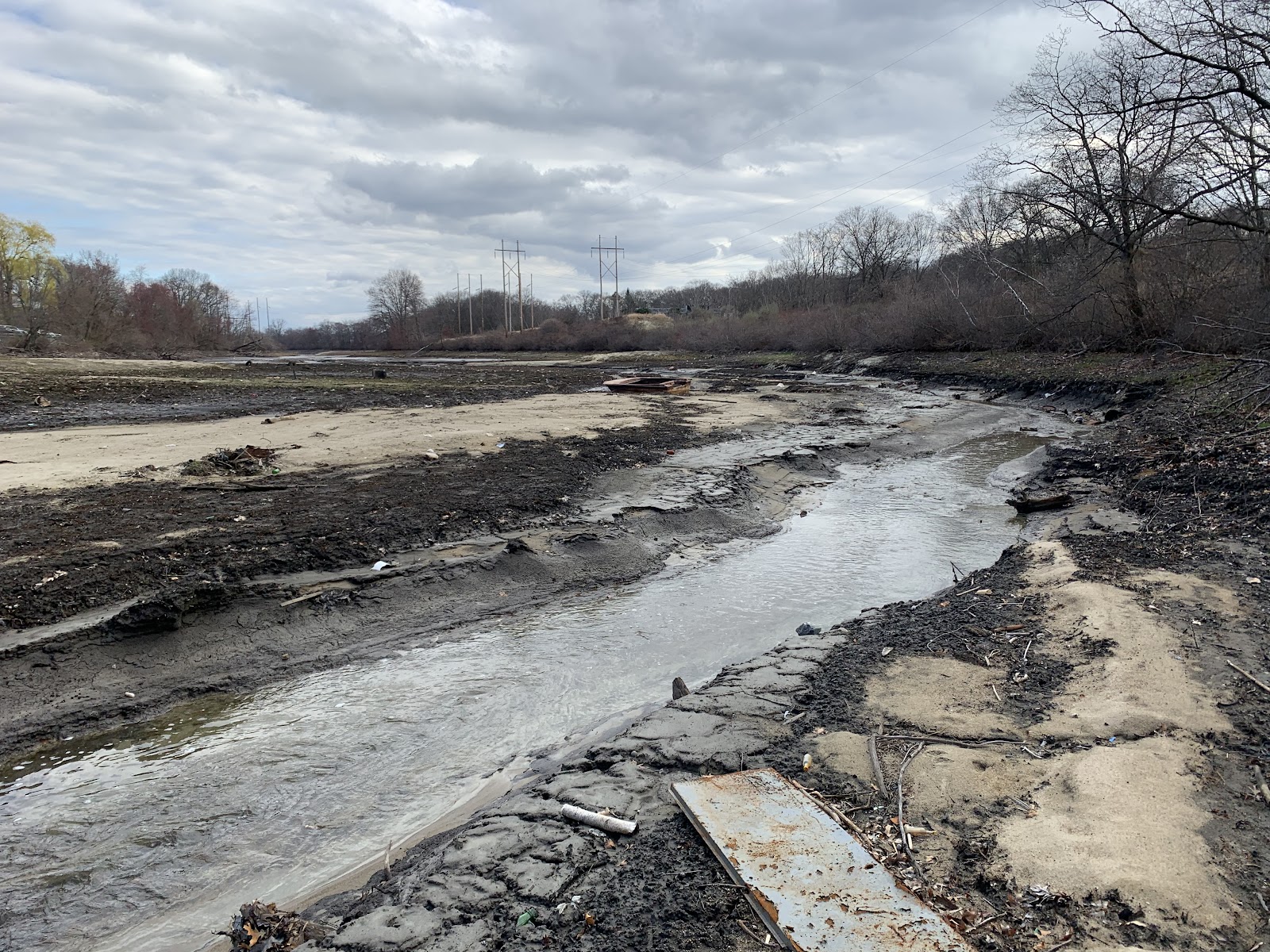
During my sort of hibernation I was taking lots of walks and found Canada Pond, this really
ugly, muddy, pond in the process of being drained near my house. On these walks I would
collect my favorite dead branches. Those became the skeleton for the piece. I had a lot of
fun lugging huge bundles of sticks through my neighborhood.
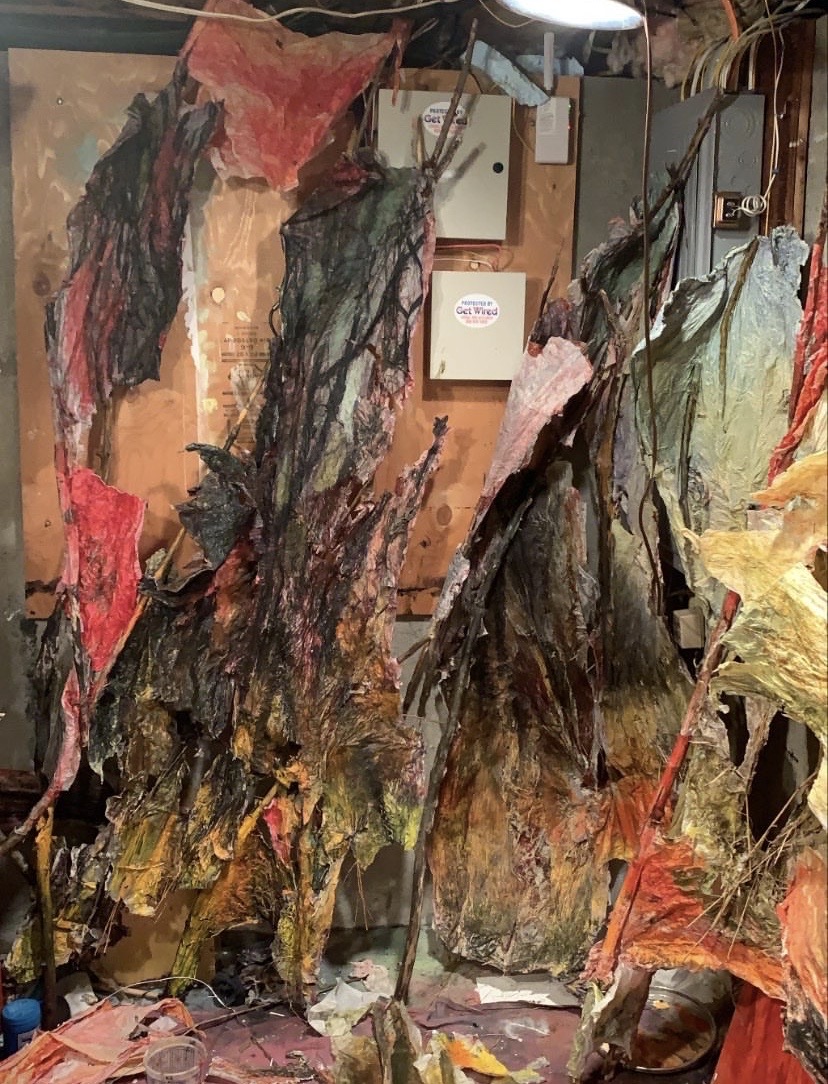
To start, I would lay out tissue paper in my driveway, and spread wheat paste on the paper,
then lay the sticks out. On top of that I would lay out another sheet of tissue paper,
sandwiching the sticks in between. Sometimes I would start with a pigmented wheat paste
and then go back in and paint on top of that. The pieces were all sectioned off to fit into my
basement where I continued to work on them and hide them from all the April rain.
The biggest challenge in constructing it was definitely scale. My first time seeing the piece
all together was when installing it. But there was something really romantic about working
on something without stepping back; or chipping away at something so much bigger than
your own body. This felt intensified when I was unable to leave the house and be away
from the work.
X: Through working in sculpture, it seems like there is a relationship to a history of landscape painting. Can you talk about your inspirations, both in relationship to the natural world and/or art history?
Absolutely, to start with the natural world, I live in Providence, off of Charles street, In the
sort of Bermuda Triangle between Home Depot, Mineral Spring, and I-95 and I take walks
almost every day. There aren't any real forests or anything, but there are patches of trees,
and ponds, and rivers. I try to travel and work from all sorts of natural, North Eastern
landscapes. But it is here, in Providence, that I spend most of my time and gather all of my
natural materials. There is something really strange and difficult to place about the little
fragments of the New England landscape that we get here. I find that making its way into
what I make more and more.
On a painterly level, I started working with the landscape about two years ago. I was really
into painting, I knew I was interested in abstraction, but I didn't know where to start. I
found that skies, trees, water, dirt, and grass could create a great framework for the
painting I was interested in. Initially, the grandeur and majesty of the American landscape
tradition and the Hudson River School painters really drew me in and acted as an
inspiration behind some of the earlier paintings I was doing. But there is also this
weaponized, and colonial history behind those paintings, as their beauty was used to
promote or justify the colonization and claim ownership over Indigenous land. That
dynamic has had me question and adjust the way I work with the landscape. I am definitely
more interested now in the idea of being inside of, or a part of a landscape rather than to
look at or represent a landscape.
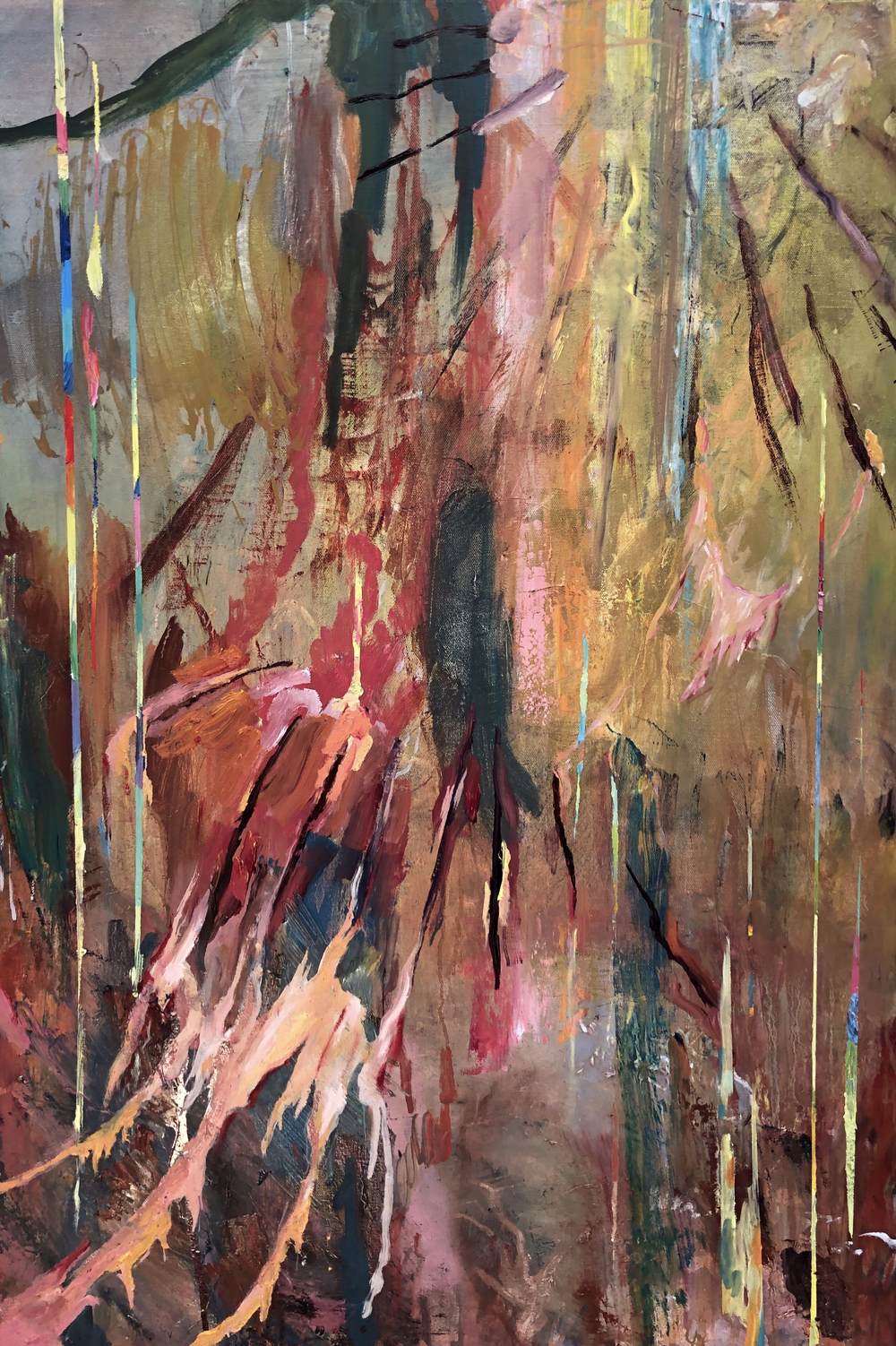
X: Yeah, I think that the tension as an artist between living inside of something versus occupying a space of representation, is a really important tension to hold because it has everything to do with subjectivity and positionality and the relationship to the thing that you are representing. So it’s really interesting to hear that that is something you're processing in a very tactile, crafting kind of way.
P: Do you listen to things while you work? Would you be willing to tell us about what you’re listening to? Does music play a role in how you engage with your process?
To be a total nerd, Pippi, I’ve been listening to that 2017 Bonedust release Fruit of the Ash
a lot and have been very very into that. That, and Kali Malone’s The Sacrificial Code, this
hour and a half long album of straight up organ and nothing else. Also, Robert Rich’s
soundtrack to the movie Stalker. Those two are very ambient, which is great because I can
totally zone in, but I am also finding that my decision making gets more free and interesting
when I’m barely paying attention to what I’m doing. Especially if I’m doubting it or
becoming overwhelmed in some way. So for that my friend has had me start listening to
the sci fi novel Dune on audio. I can already feel that working its way into things.
X: You’ve spent the year applying to school and making plans for your year. How has all of this affected your thinking about the future? About planning? About the potentials and limits of artmaking as a communicative medium?
This past year I’ve totally been in a weird state trying to plan for and anticipate the future. I
was trying to make work without thinking too much about it which proved to be impossible
because it was all I could think about.
I ended up getting into Cooper Union, and decided to go, which I am ecstatic about. I also
decided to take a gap year in hopes that NYC/the world can adapt and begin to recover
before I move into such a new and already fragile part of my life. So for the first time in
fourteen years I’ll be living completely outside of school. I’m realizing I need to be living and
making work in ways that are more present. For so long I’ve felt like I'm working towards or
waiting until the next thing, whatever that may be. Now no one knows what’s next and all
we can do is take things a day at a time. That is definitely what I need to do right now to
stay sane and I also know it’s what's best for art making.
It definitely has me questioning art as a means of connection as well. My practice has been
a great way to learn to spend more time with myself. But even before all this, I was feeling
a need for more shared connection and ritual-like activity in my life, and that art could be a
place to seek that out. Lately I’ve been thinking a lot about work that exists in the physical
realm and could promote both shared experience and distance. Possibly something
mailable, tradable, and zine like, or some sort of quasi-public sculpture made for others to
visit and contribute to. I'm brainstorming!
X: Your paper mache in this piece, as well as your other work has elements that feel both ethereal like clouds or sea foam, but then there are other aspects that are carcass-y or like dried out flowers in a bouquet that’s been on a desk for longer than intended. In this there is an allusion to both time and the body. Can you speak to this? It also feels like when you make references to death or the remains of plant/animal life, there is a reverence. The gestures are quiet, rather than violent. Is there an ethics around representation that you’re working with explicitly or feeling your way through?
For sure, I've definitely stumbled into these areas. I had this really great critique maybe two
years ago when I was making paintings of friends in fields of flowers. I felt like the work
was really joyful and all about friendship but the cold read I got from others was all about
how the figures were either zombies or they were hiding from zombies. This initially felt like
something I could ignore. But as I continued working I realized how present birth, growth,
decay, death, and rebirth were in my work. Maybe not in a “zombie” sort of way, but
definitely in a way that hints at some larger narrative or cycle.

I am trying to examine these themes and make work that can move fluidly along those
cycles rather than getting stuck on one end. Like for example, I made a lot of sculptures
this past year that have corpse-like elements and sit or lie on the ground. More recently I
have felt that it is important that the sculptures begin to stand up or have some sort of
responsibility to themselves, like to point at a spot in the sky, or to carry water. I hope
something in those actions lend themselves to a greater, more hopeful, and generative
narrative, rather than just an ending. I certainly want there to be hope in each piece.
P: What things feel most hopeful to you at this moment?
Knowing that we’re not going back to normal. Which is difficult and feels a little empty to
say because we have no idea what that is going to look like right now. We know there will
be great change, and much of it will be upsetting for a while, but I am optimistic that there
will be positive and unexpected shifts to look forward to.
X: As a young person circulating in ideas and images and culture as a field, are there things that feel visible to you that you think may be blindspots to practitioners of other generations? Concepts or values that you don’t think are relevant that you’d like to see let go of?
It totally goes without saying, but just being inundated with the sheer volume of ideas and
images we are is immense and at times cacophonous. We’re navigating more tools and
information than we know what to do with. It's difficult to see exactly how that's impacting
our work as young people, probably because it’s still and always unfolding. But what I am
seeing right now is a breaking down of boundaries on social, personal, and informational
levels. Some of this is excessive and leaves us raw, but when it comes to access, there's
an advantage to having so much in the open. I think we are navigating access more
intimately now. To pick the most obvious example, we have memes: these easily
disseminated images, dense with meaning and connection, that can be experienced by
tons of people. I am excited to see how these values could push our artwork and draw
greater attention to the hurdles placed around art. And that's not to say there isn’t value to
the more intimate connections that can be made in art, or that everything must be widely
experienced to be successful. I don't think all of the solutions will be found in
dematerialization, digitization, or making work that is as easy to digest as a meme. But, I
am definitely hoping we can invest ourselves more in access and heart clarity, and less in
over-intellectualization and total obscurity.
|
This project was made possible through support from the City of Providence, Art Culture + Tourism Department |
Monday, April 20, 2020
orange ya glad i didn't say unprecedented times
| ||||||
| ||||||
| ||||||


Subscribe to:
Posts (Atom)
